ProLabs Launches Next-Generation 1.6T OSFP224 2xDR4 Transceivers and Direct Attach Cables for High-Performance Data Centres
Unlocking Network Agility with Flexible, Tunable DWDM Technology
Tuneable DWDM technology leverages the ability of transceivers to be flexibly reprogrammed, allowing them to receive signals on any desired channel regardless of their initial configuration. This dynamic capability is achieved by utilising existing physical layer infrastructure while performing advanced signal processing within the radio frequency band. Available in various form factors—including 1G, 10G SFP+, XFP, and 25G SFP28—tuneable DWDM transceivers offer an increasingly accessible and cost-effective solution for modern data networks. This foundational flexibility is now extending to higher speeds like 100G, 400G, and even 800G coherent optics, becoming critical for the scalability of next-generation infrastructure. By adopting this technology, network operators can respond rapidly to changing demands with greater agility and significantly reduce the need for extensive spare inventory.
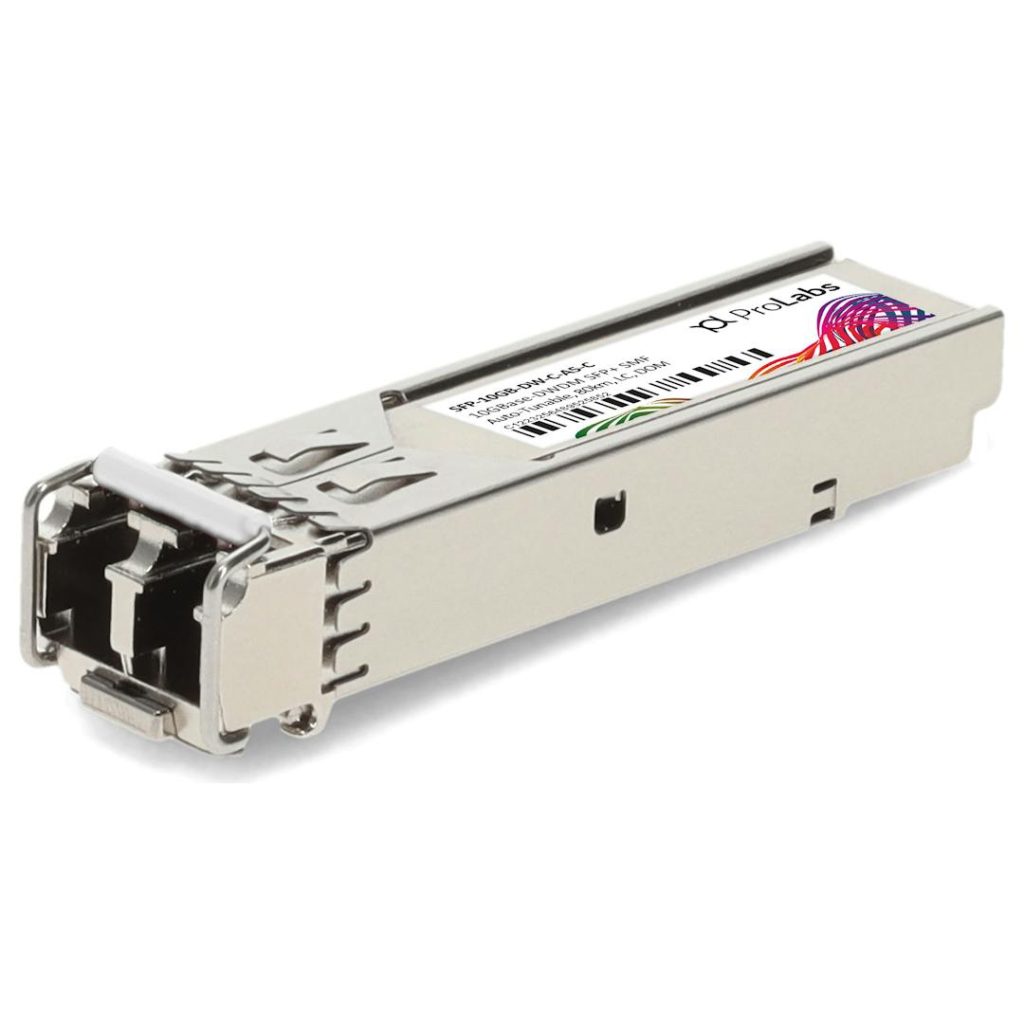
MSA and TAA 10GBase-DWDM 50GHz SFP+ Transceiver (SMF, Auto-Tunable, 80km, LC, DOM, 0 to 70C) | SKU: SFP-10GB-DW-C-A5-C |
Tunable vs. Fixed-Wavelength Optics
Wavelength Adaptation
In traditional DWDM systems, fixed-wavelength transceivers are designed to operate at a specific, unchangeable wavelength. This means each optical module can only be deployed at the network node that requires that exact wavelength. For example, an SFP+ transceiver configured for channel C21 must connect to a port designed for C21. This rigidity limits network flexibility and requires precise inventory management.
In contrast, tuneable DWDM transceivers can be dynamically reprogrammed to transmit and receive on any wavelength within a designated range. This flexibility allows a single tuneable transceiver to connect to any port on the same multiplexer (MUX) by adjusting its wavelength as needed. As a result, tuneable optics enable network operators to adapt quickly to changing network configurations without physically swapping modules.
Reduction of Inventory
Beyond wavelength flexibility, one of the most compelling advantages of tuneable DWDM technology lies in its impact on inventory management.
Networks using fixed-wavelength optics often need to stock a wide variety of transceivers to cover all possible wavelengths in use. This approach ties up capital in inventory and reduces operational agility, as each channel requires a dedicated spare transceiver.
Tuneable DWDM transceivers dramatically reduce this burden by serving as versatile spare units that can be tuned on demand to any required wavelength. Instead of maintaining dozens of fixed-wavelength spares, operators can keep fewer tuneable transceivers in stock, cutting costs and simplifying logistics. This on-the-fly adaptability makes tuneable optics a cost-effective solution for networks with evolving or expanding channel requirements.
Long-Term Benefits and Cost Efficiency
While fixed-wavelength transceivers generally have a lower upfront cost, the total cost of ownership favours tuneable optics in dynamic, large-scale networks. For example, a 10G DWDM system with hundreds of nodes using different wavelengths requires a broad inventory of fixed-wavelength spares to prevent downtime, significantly increasing operational expenses.
By replacing fixed-wavelength modules with tuneable transceivers, network operators benefit from reduced inventory complexity and enhanced flexibility to accommodate network growth or reconfiguration. This leads to lower operational costs and improved business continuity over time, making tuneable DWDM technology a strategic investment despite its higher initial price.
Moreover, the agility offered by tuneable transceivers is becoming indispensable for modern network architectures. They are key enablers for Software-Defined Networking (SDN), allowing network operators to provision and reconfigure optical paths remotely and automatically, dramatically reducing manual intervention. This level of programmability is crucial for current and future applications such as 5G xHaul (fronthaul, midhaul, and backhaul) where rapid deployment and dynamic capacity adjustments are vital. It is also crucial for optimising Data Centre Interconnects (DCI), where high-capacity, flexible links are essential for cloud computing and AI workloads. Tuneable optics ensure networks can scale efficiently and adapt to the ever-increasing demands of data traffic and emerging technologies.