How 5G Fronthaul Networks Are Evolving with Active Optical Cables
As the demand for high-speed wireless connectivity explodes, 5G networks are becoming the backbone of mobile infrastructure worldwide. At the heart of this revolution sits the 5G fronthaul network, responsible for carrying critical data between the base station and the core network. Delivering low-latency, high-throughput, and reliable performance has never been more important.
But how do we power the fronthaul to meet these ever-increasing demands? The answer, more often than not, lies in Active Optical Cables (AOCs) — compact, high-performance connectivity solutions that are increasingly becoming key enablers for seamless 5G deployments.
Let’s explore how Active Optical Cables are evolving 5G fronthaul networks and why they’re the solution of choice for modern telecom operators.
What Are Active Optical Cables (AOCs)?
Active Optical Cables are an evolution of fibre optic technology that combine the benefits of fibre—high bandwidth, low latency, immunity to EMI—with the convenience of installed copper cables. They are fibre optic cables with built-in transceivers at each end that perform conversion.
This simplifies the deployment process dramatically. Unlike FRUs (field-replaceable units) with discrete fibre optic modules, AOCs are ready-to-use point-to-point transceivers within a single cable.
Why 5G Fronthaul Needs Active Optical Cables
Traditional approaches to 5G fronthaul often rely on back-to-back networking with bulky transceivers, complex cabinet setups for passive components, and expensive installation processes. Here’s why active optical cables are changing the game:
1. Bandwidth-Centric Designs
5G, especially in dense urban environments, requires massive bandwidth. Multi-gigabit speeds and high-channel counts mean traditional copper-based backhaul just isn’t cutting it anymore. Fibre optic cables—especially when combined into compact AOCs—provide the sheer capacity needed.
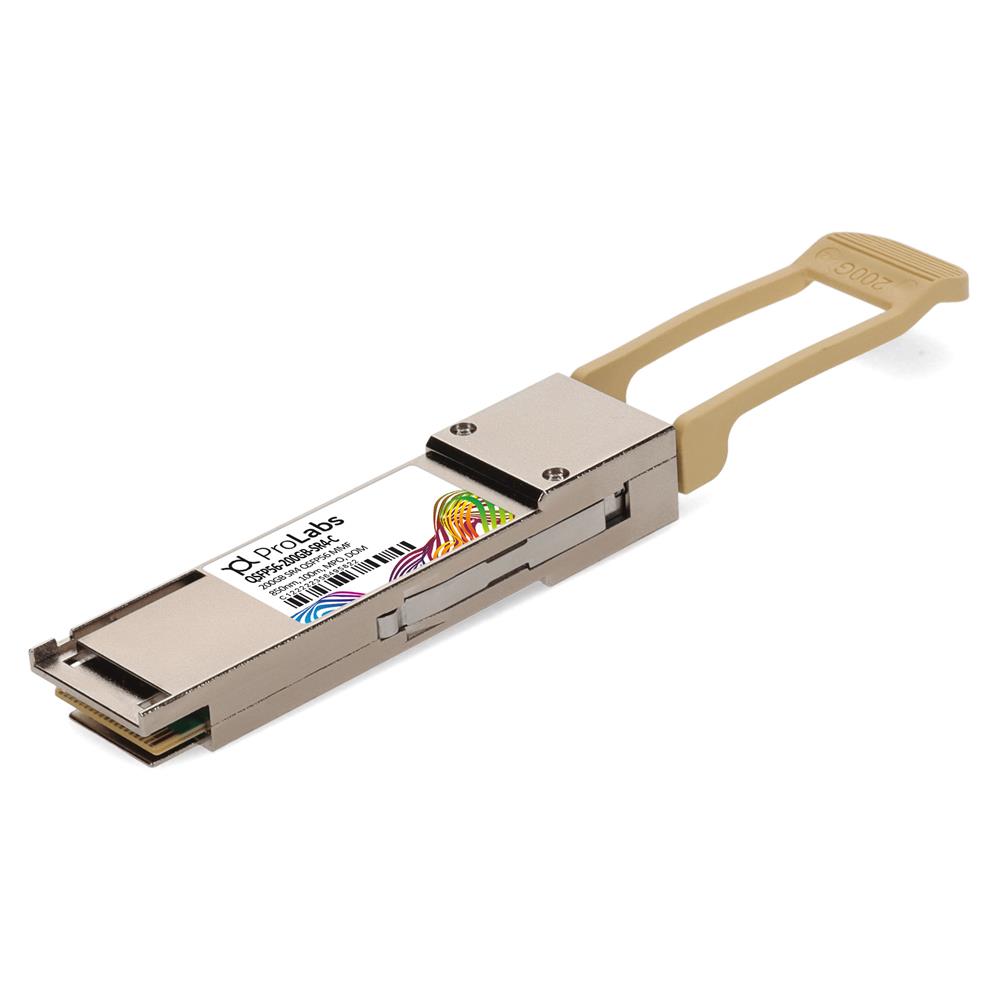
MSA and TAA 200GBase-SR4 QSFP56 Transceiver Infiniband HDR (MMF, 850nm, 100m, MPO, DOM) | SKU: QSFP56-200GB-SR4-C |
2. Compact and Versatile
AOCs are the epitome of plug-and-play. They come in standardised form factors and interface types, such as SFP56, QSFP56, QSFP28, SFP28, and others.
- FDD: AOCs can easily break out ports for multiple base stations from one interface.
- TDD: High-frequency signals requiring low latency find perfect partners in AOC implementations.
Their flexibility gives network operators the ability to scale and reconfigure networks with minimal downtime.
3. Reduced Total Cost of Ownership
Are you worried about the cost of deploying tens of thousands of fibre links? Active optical cables can drastically cut costs associated with deployments:
- They eliminate costly discrete transceivers.
- They reduce installation time and complexity.
- They are compatible with virtually all existing networking equipment, from 5G base units to core-facing switches and routers.
4. Improved Power Efficiency
AOCs are passive between the ends (there is active electronics at each end though) so they dramatically reduce the need for optical transceivers and their power requirements. This efficiency is especially valuable in 5G, which commonly relies on dense city deployments.
Real-World Applications
We’ve seen active optical cables deployed globally in:
Wireless Cloud RAN (Centralised RAN): AOCs connect remote radio heads (RRHs) directly to centralised units (CUs) across multiple base stations, ensuring bandwidth without bottlenecking in the central infrastructure.
Multi-Operator Sharing (MOS): With AOCs, different operators can share 5G fronthaul infrastructure without interference.
DAA (Dense Access Area) & DAS (Dense Access Strips): AOCs help deliver high-density connections without compromising fibre count.
Overcoming 5G Connectivity Hurdles
Adopting AOCs isn’t without challenges. Deployment processes often require specialised tools and deep expertise for maximum yield, and careful testing must be maintained during fibre link verification.
However, solutions like ProLabs’ MPO breakout AOCs, for example, are designed for rapid deployment—meeting or exceeding industry standards for reliability.
Field-deployable ruggedised cables are another must-have for outdoor installations, ensuring high survival rates in harsh conditions.
The Road Ahead for 5G with Active Optical Cables
Looking ahead to the evolution of 5G infrastructure – 5G Advanced and 6G networks on the horizon – the role of AOCs will only become more critical.
With data traffic predictions showing internet traffic growing by 3.5% per year (and that’s projected to increase by 28% within the next five years, reaching well over 70 exabytes monthly by 2030), AOCs will be the key to keeping up with these demands.*
Need help scaling your 5G fronthaul? Think about solutions that combine high performance, cost savings, and flexibility—Active Optical Cables deliver just that.
Ready to make the leap? Explore our range of high-speed optical connectivity solutions today.